


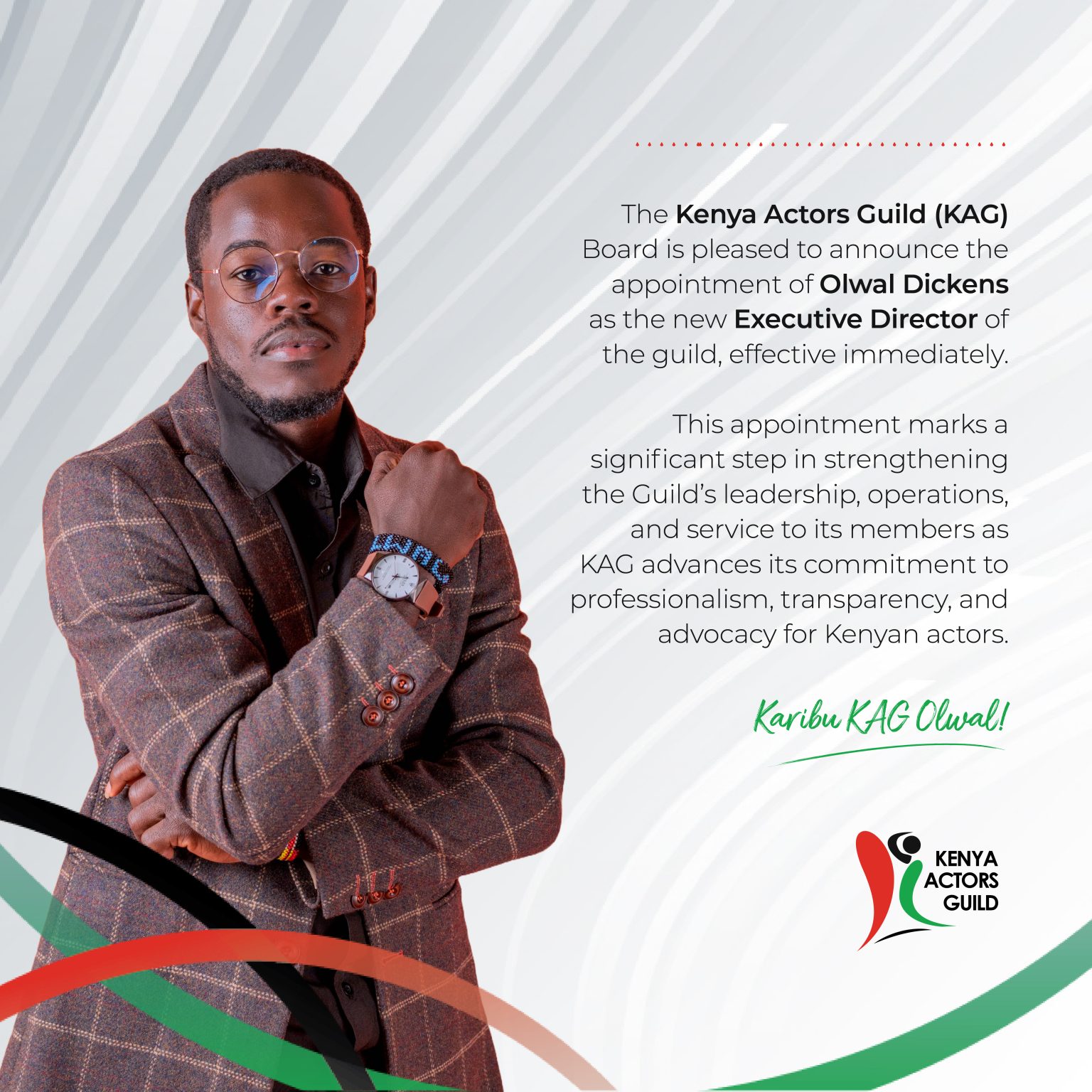

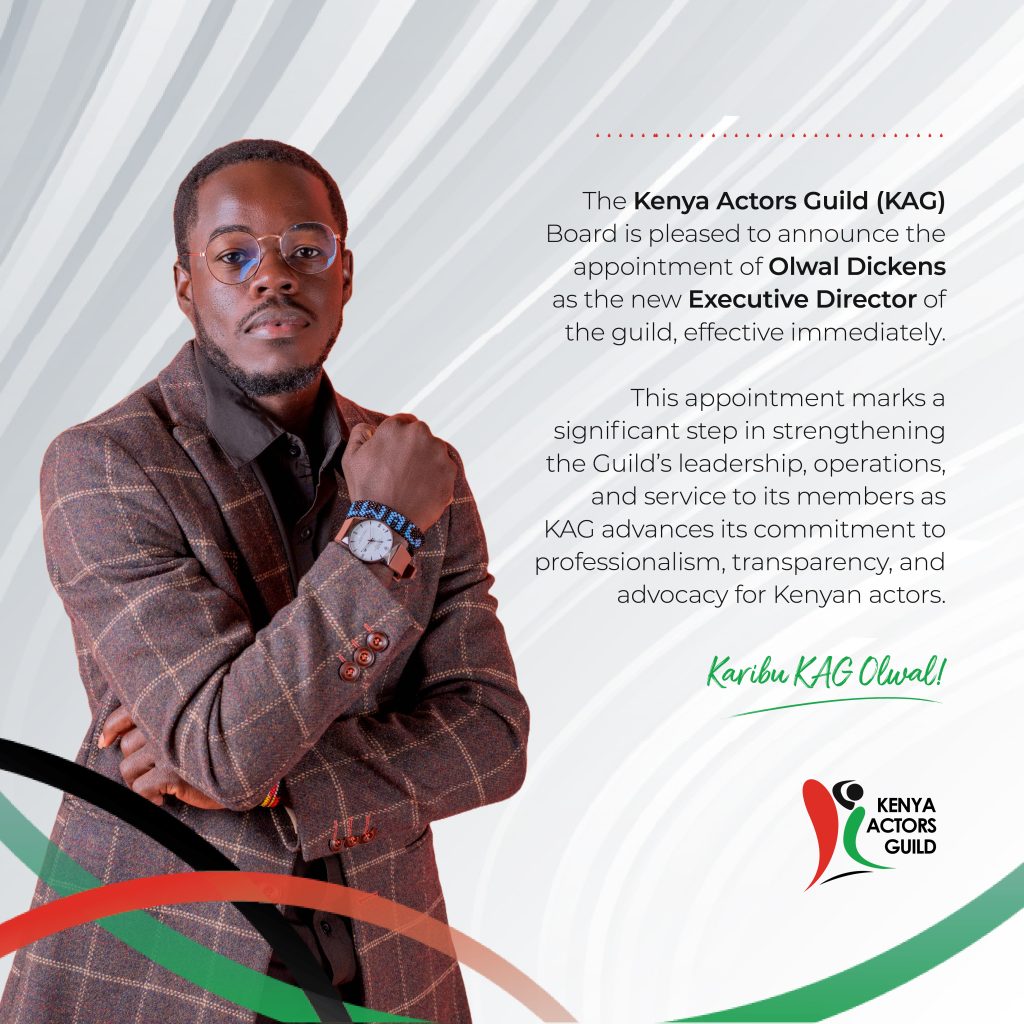
The Kenya Actors Guild’s appointment of Olwal Dickens as its Executive Director represents a critical institutional evolution that speaks to broader questions about how creative sector organizations can sustain effective advocacy in an increasingly complex industry landscape. A year after Peter Kawa’s administration came to power, the Guild has created a professional management position that fundamentally restructures how it operates.
The decision to establish an Executive Director role emerges from a clear-eyed assessment of volunteer governance limitations articulated by William Mwangi, the Guild’s Head of Legal Affairs, speaking on behalf of the leadership. His diagnosis identifies operational gaps that will sound familiar to anyone who has worked with volunteer-led member organizations, including, delayed execution on planned initiatives, inconsistent communication with stakeholders and members, and difficulty maintaining momentum on strategic priorities. These are fundamental constraints that directly limit an advocacy organization’s effectiveness in representing its constituency.
The structural challenge is straightforward, management committee members at KAG hold positions including Chairman, Secretary, Treasurer, and various department heads covering welfare, programs, finance, membership, legal affairs, and marketing. Each of these individuals brings professional expertise and genuine commitment to advancing actors’ interests, but each also maintains a career outside the Guild that demands their primary attention and provides their livelihood. The episodic availability of volunteer leadership becomes a binding constraint on what the organization can accomplish.
In governance as in warfare, structure determines capacity. As Sun Tzu observed, strategy without tactics is the slowest route to victory, while tactics without strategy amount to noise before defeat. KAG’s appointment of an Executive Director represents the tactical infrastructure necessary to execute strategic advocacy, converting board vision into sustained operational reality.
The creation of an Executive Director position addresses volunteer limitations by establishing what Mr. Mwangi describes as a dedicated day-to-day executive function capable of ensuring continuity, follow-through, and institutional memory. This is about creating organizational capacity to engage seriously with the expanded scope of work that contemporary advocacy demands. As Kenya’s creative economy attracts increased investment, the organizations claiming to represent those workers must be capable of sustained, professional engagement with policymakers, industry stakeholders, and international partners.
The governance restructuring that accompanies this appointment reflects established nonprofit management principles about the appropriate division of labor between boards and executive staff. Consider it like The Godfather, where the board sits as the Don, making strategic family decisions about advocacy priorities and organizational direction, while the Executive Director serves as the consigliere, managing daily operations, maintaining stakeholder relationships, and ensuring the family’s decisions translate into action on the ground. This separation allows elected volunteer leaders to concentrate on the advocacy mandate and long-term vision rather than getting consumed by administrative logistics and daily coordination tasks, making it more effective at achieving its core mission.
Dickens brings relevant capabilities to this role through his background managing the KitFest and Kenya Theatre Awards, which demonstrates both organizational capacity and industry credibility. His stated commitment to balanced representation across stage, screen, and digital platforms addresses a genuine challenge within KAG’s diverse membership. Theatre practitioners, film and television actors, and digital content actors work under substantially different conditions with distinct professional concerns, and effective advocacy requires understanding these varied contexts. An Executive Director who has worked across these platforms and who understands their different operational realities is better positioned to ensure the Guild’s advocacy resonates with its full membership.
By prioritizing the creation of a small operations team and the development of reliable systems and processes, Dickens signals an understanding that credible advocacy requires organizational capacity that can outlast individual personalities and survive leadership transitions.
Of course, structural elegance on paper does not guarantee operational success in practice. The critical questions remain unanswered: Can an organization that took eighteen years to professionalize basic management functions realistically expect administrative capacity alone to translate into the political leverage necessary for meaningful policy wins? The appointment addresses KAG’s operational dysfunction, but whether it can generate the stakeholder influence and member value that justify the investment remains an open empirical question.
What this appointment ultimately represents is a recognition that as Kenya’s creative economy matures and the challenges facing actors become more complex, the advocacy organizations serving them must evolve beyond purely voluntary structures to remain relevant and effective to shape actors’ working lives and economic security.