





Professor Utonium, in his infinite wisdom, created the Powerpuff Girls with sugar, spice, and everything nice, except he added one ingredient: Chemical X. Watching “In the Seashell Hum,” I kept wondering what ingredient Director Victor Gatonye accidentally added, or didn’t add, that disturbed the whole equilibrium. Because something did.

The biggest issue with adapting a play is, as I said, class, you also inherit its weaknesses. Adipo Sidang’s play as a book may be wonderful, but as a stage play, we need to stop and ask ourselves some important questions before proceeding. Questions like: Is this story better served by movement than dialogue? And most pressingly, what can the stage offer that the page cannot?
The play follows Baraza, a man unravelling under the weight of voices in his head. He and his comrade Athman survived the sinking of their naval vessel, and Baraza is convinced it was no accident, the only witnesses being him, Athman, and Seashell Radio. At its core, the play wants to show how mental illness doesn’t just consume the individual; it ripples outward, touching everyone around them. Staged in May, Men’s Mental Health Month, with weekly activations around themes of masculinity and the boy child, the ambition is clear.
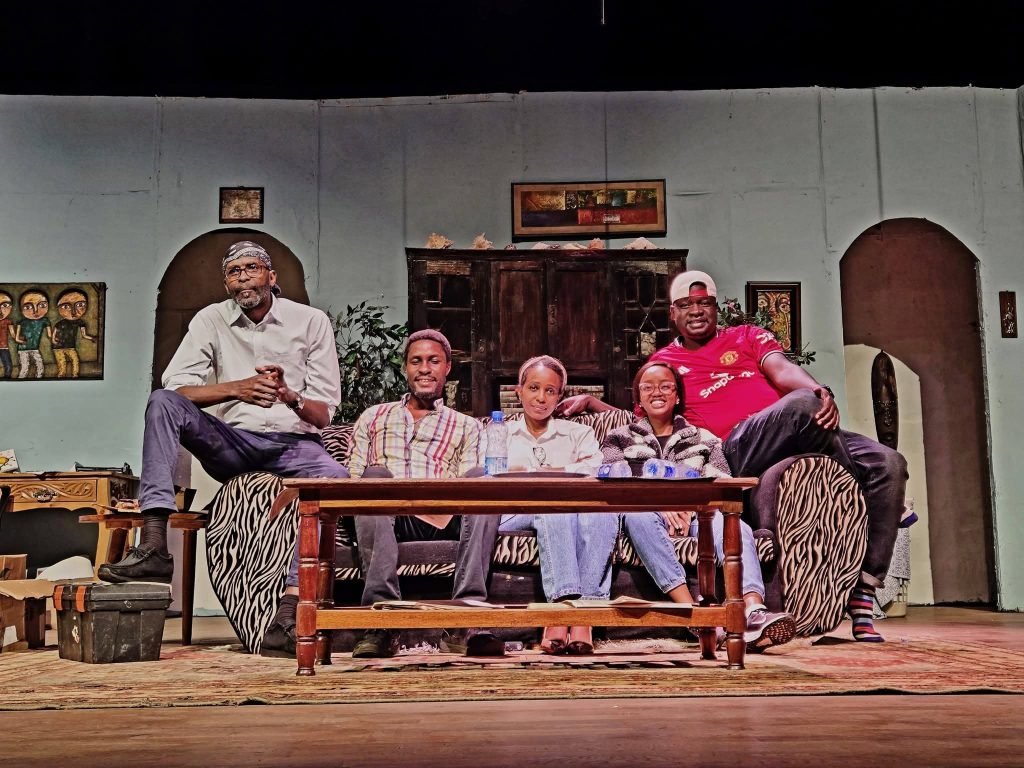
When your source material is heavy in dialogue, the remedy is a stellar cast, vessels through whom the audience lives the story. Beyond that, you make bold choices. You find what the stage can do that the book cannot: the movement, the silences, the use of space. You compensate for the text’s weight with physical and visual storytelling. You give us a reason to be in the room rather than at home with the book.
And they did get Nick Ndeda, who is absolutely that. His Baraza, compelling, grounded, genuinely disturbed, does the work. There is a particular kind of courage in playing a man whose own mind is his enemy, and Nick brings it fully: the restlessness, the paranoia, the moments where his alcohol becomes his crutch. He carries the play with the conviction of a man who understood the assignment and showed up. The problem is that the ship he is sailing is made of Manila paper.
Because reciprocity of energy matters, and here is where the holes multiply.
Foi Wambui, a multi-hyphenate creative known, per the programme, for her range, versatility, and emotional depth, arrives as Salma, and we were ready to receive every bit of it. Unfortunately, Salma seemed to have wandered in from a crossover episode: somewhere between Mr. Peanut Butter‘s relentless, oblivious sunshine and Bojack Horseman‘s spiral, without committing to either. Playing opposite a man visibly unravelling, she performed as though she was warming up for a Crony play, waiting for someone to cue the laugh track. Rounding out the cast, Gitura Kamau took on Athman, the voice inside Baraza’s mind, alongside Angie Mwandanda, with Mr. Ben Tekee appearing briefly as the doctor. His arrival at the very end was, if nothing else, a timely reminder that treatment options exist.

What consistently worked was the sound. Musyoka, an award-winning sound and music director, gave us a soundscape that made the world of the play genuinely tangible, including the noise of the street below, the static of a radio carrying secrets. In the moments when everything else stepped aside, the sound did the heavy lifting.
The set was also a problematic area, it was too bulky, and the stage crew’s leisurely approach to scene changes, however technically valid the in-view costume technique may be, kept pulling us clean out of whatever spell the play was trying to cast.
A play that packages itself as urgent social commentary owes us an evening that matches that urgency. The conversation around men’s mental health is one worth having, it deserves a production that can carry its weight. We are not required to be grateful for theatre simply because it showed up, especially theatre touring six cities across East Africa carrying a message this important.
When a director looks down at their material and realises they are steering a dialogue-heavy, thematically murky ship into choppy waters, there is a protocol. Stop. Drop. And roll or in theatre terms: workshop it, strip it back, make it truly yours.
In the Seashell Hum hums on in Mombasa, Malindi, Kisumu, Eldoret, Nakuru, Kampala, Dar es Salaam, may you find ingredient X on the road.
To book exclusive events with a TICKETING PARTNER visit tickets.sanaapost.com 😎👊🏿